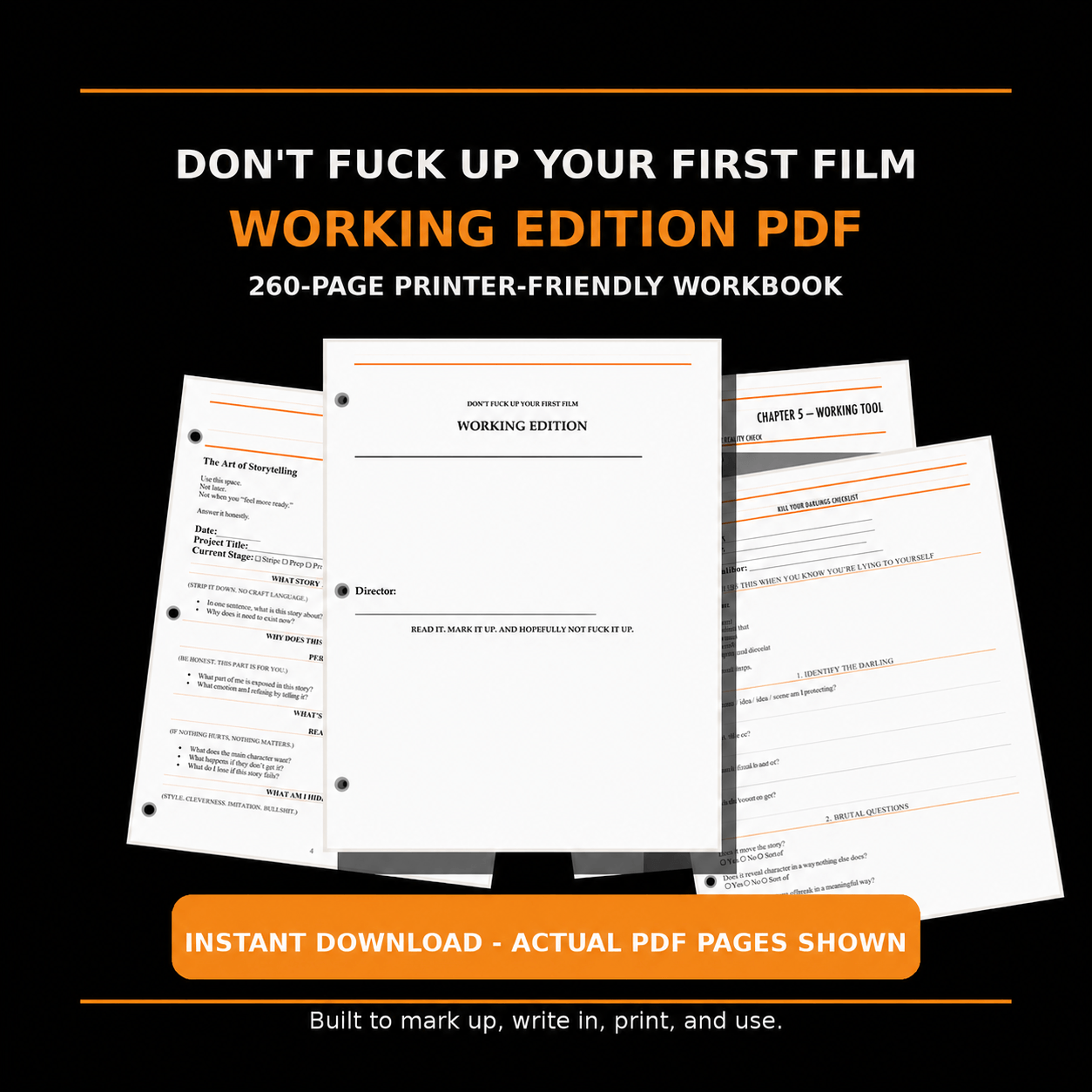
Don’t Fuck Up Your First Film:
The Working Edition
This isn't a book you read once and shelve.
It's a production tool you write in, argue with, and bring to set.
260 pages. 12 chapters. Working tools after every chapter.
Built for prep, production, and post — before things go sideways.
Less guessing. Fewer blind spots.
Better decisions before the shit hits the fan.
You’ve got an idea. Maybe even a script.
Here’s what nobody tells you:
Most first films crash long before the credits roll.
Not because of talent.
Because of blind spots.
Bad prep kills morale.
A rigid shot list turns into a trap.
Weak sound wrecks good images.
Festival programmers give you 30 seconds, and they’re not grading on effort.
These aren’t reasons to quit.
They’re the problems this workbook helps you catch early.
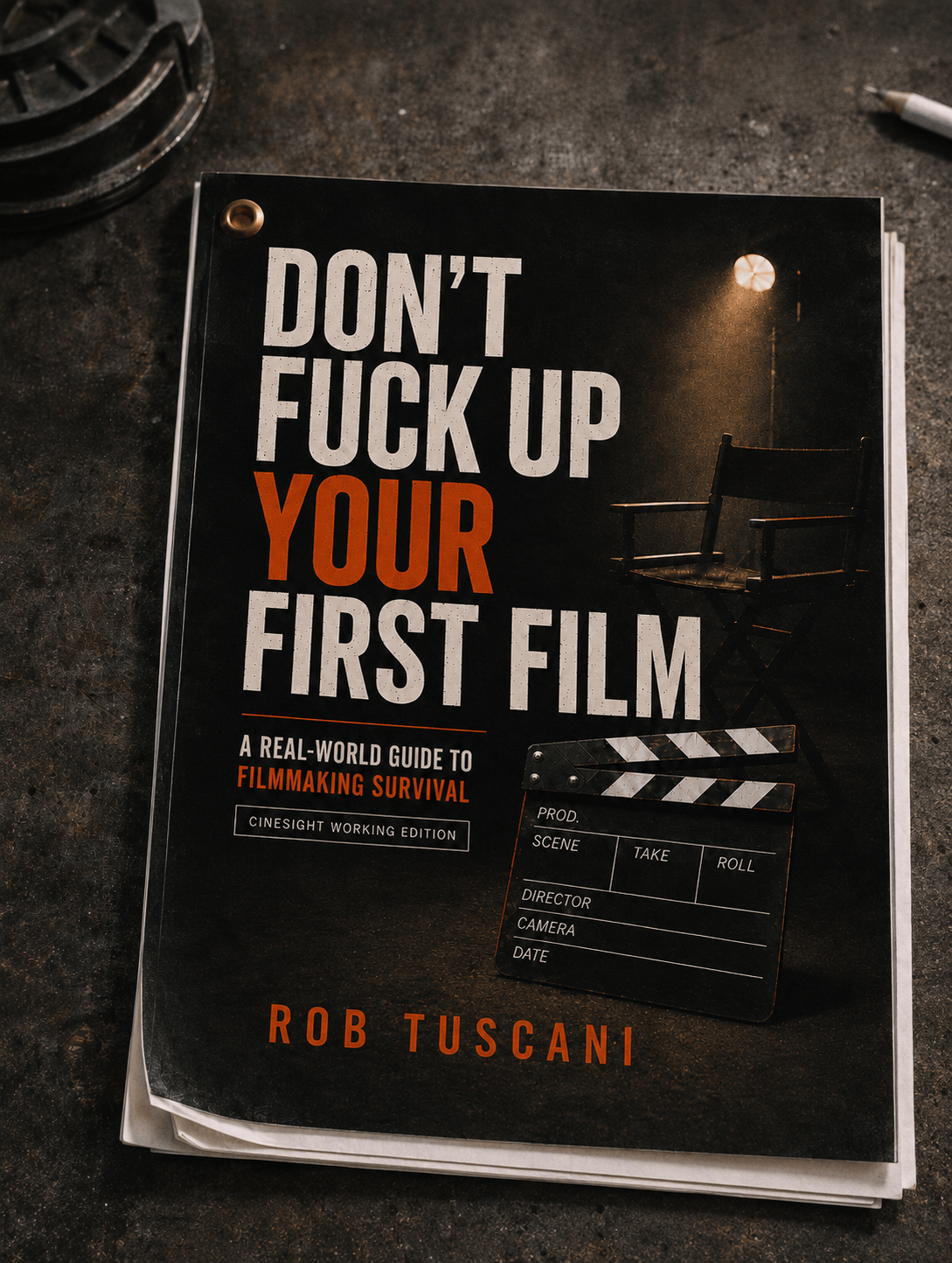
What you’re getting:
A 260-page printer-friendly Working Edition PDF.
The cover image above is a visual mockup.
The actual download is built for use: clean pages, working tools, checklists, forms, and less ink-draining nonsense.
Print the Stage You’re In
Print the Stage You’re In
You don’t have to print all 260 pages.
Print the chapter and working tools your film needs right now.
Story. Script. Prep. Production. Edit. Festivals. Launch.
Use it when the decisions are still alive
Not a Course. A Working Guide for Your First Film.
A prompted field manual for turning an idea, script, or half-formed plan into something you can actually shoot, finish, and release.
I’m not promising you success.
I’m not selling a secret formula.
And this won’t magically fix talent, timing, or luck.
This guide exists for one reason:
Most first films struggle because the important decisions get skipped, rushed, or made too late.
This workbook helps you slow down and work through those decisions while they can still improve the film.
What story are you really telling?
How do you make the script stronger before production?
How do you direct actors toward something truthful?
What shots actually serve the scene?
How do you make the film look, sound, and feel more intentional?
What does the edit reveal after the shoot is over?
How do you get the finished film seen?
That’s the work.
Not just avoiding mistakes.
Making clearer choices before the movie starts making them for you.
Because your first film is already hard enough
without paying extra for avoidable mistakes.
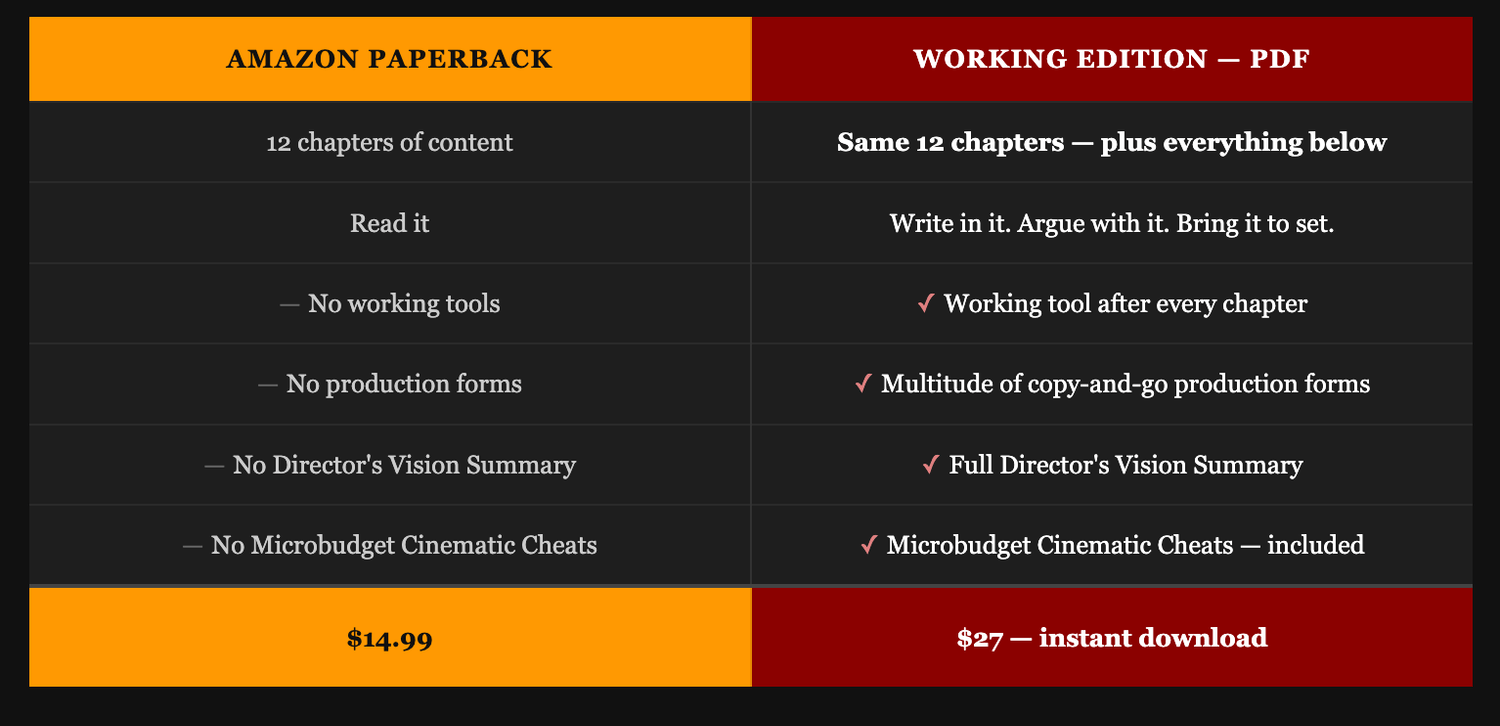
The Amazon paperback is the core guide.
The Working Edition is the expanded workbook: tools, planning pages, and production forms you can actually use.
What Filmmakers Are Saying
“It’s not theory. It’s what actually saves your ass on set.”
— Joseph A. Lemieux- Producer
★★★★★ · Verified Purchase
“Feels less like a textbook and more like a mentor walking you through the trenches.”
— Brandon Paige-Producer/Studio Owner
★★★★★ · Verified Purchase
"He gives you what you need to hear. No fluff.”
— R. Hofmann-Producer/Director
★★★★★ · Verified Purchase
"It skips the theory and focuses on real choices, real problems.”
— R. Simmons-Actor
★★★★★ · Verified Purchase
★★★★★ Rated 5.0 on Amazon by verified buyers
After nearly 40 years on sets and in classrooms, I’ve written the guide
I wish I’d had before my first shoot.
Chapter working tools include:
Scene intention sheets
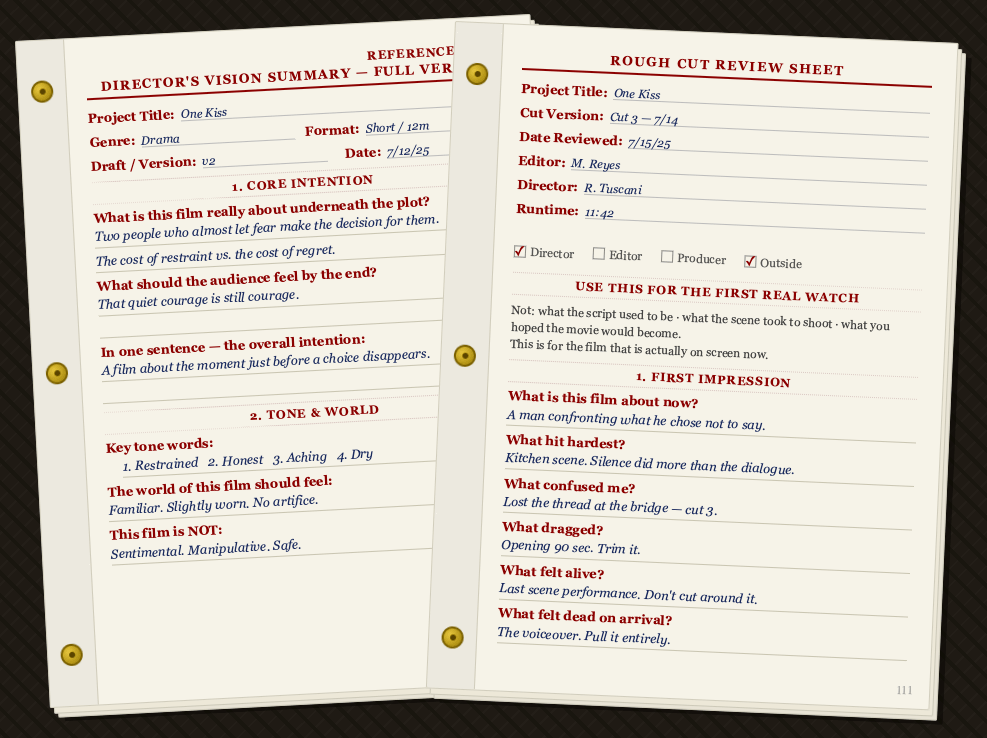
Director's vision summaries (short and full versions)
Daily reality checks
Rough cut review sheets
Kill Your Darlings checklists
Festival submission trackers
Launch reality sheets
Postmortem/lessons learned pages
Next film seed sheets
AI Tool Reality Check
Human Edge Checklist
Back-of-book production forms — copy and go:
Call sheet
Shot list page
Scene breakdown page
Daily schedule/day plan
Equipment checklist
Location info sheet
Props / wardrobe / continuity log
Release form tracker
Plus:
Microbudget Cinematic Cheats — how to make it look like a real movie without lying to yourself
Director's Vision Summary (full version) — the document your whole crew aligns to before day one
Glossary — the terms people throw around like everyone's born knowing them
Why the Working Edition costs more than the paperback
The Amazon paperback is the core guide.
The Working Edition is the tool.
It gives you the same 12-chapter foundation, plus working pages, production forms, planning sheets, and reference material built to help you make decisions before they cost you time, money, or morale.
If this saves you one blown shoot day, one wasted festival submission, or one avoidable crew meltdown — it's paid for itself twenty times over.
$27. Instant download. No upsells. No tiers. No mastermind waiting behind a paywall.
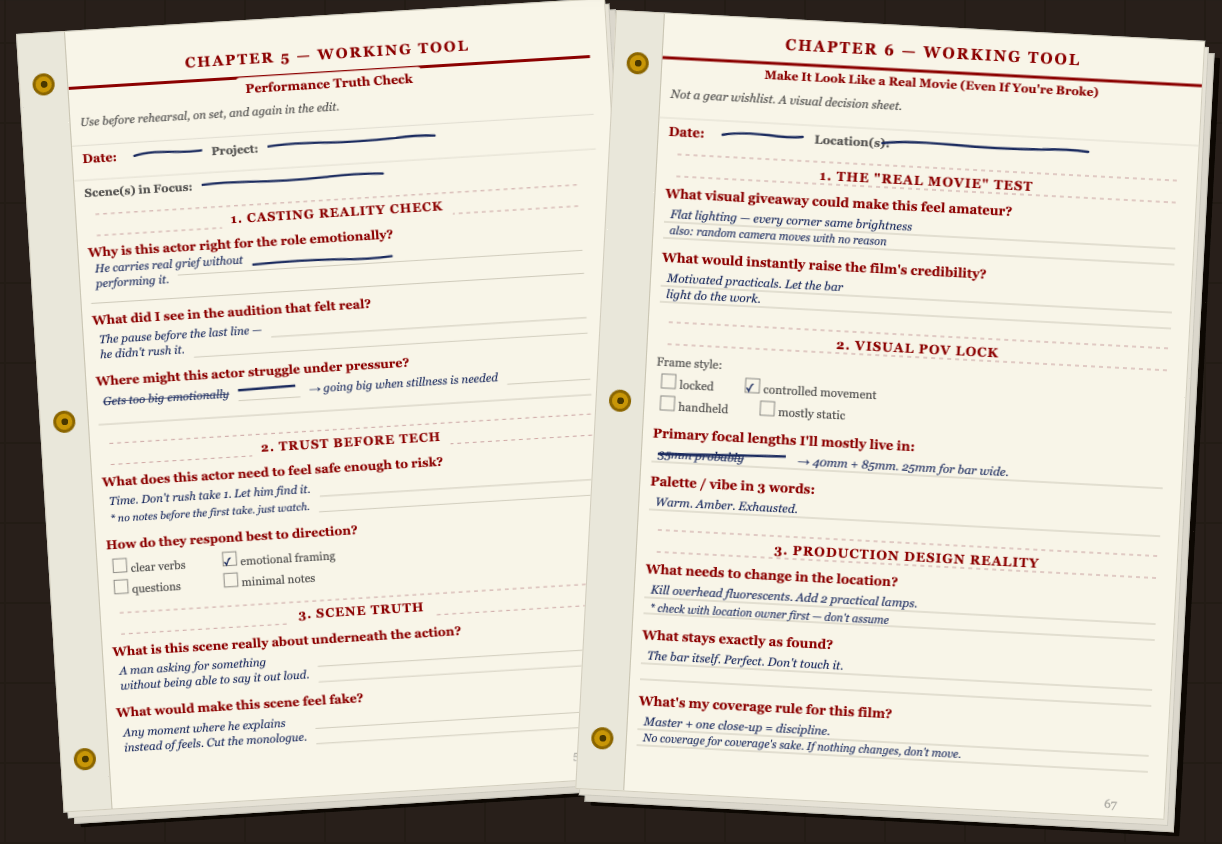
A Quick Look Inside the Working Edition
These aren’t filler pages.
They’re working tools built to help you make a better film: clearer story,
stronger prep, more truthful performances, smarter shots, cleaner edits,
and fewer “why didn’t I think of that sooner?” moments.
Not paperwork.
Decision-making before the damage gets expensive!
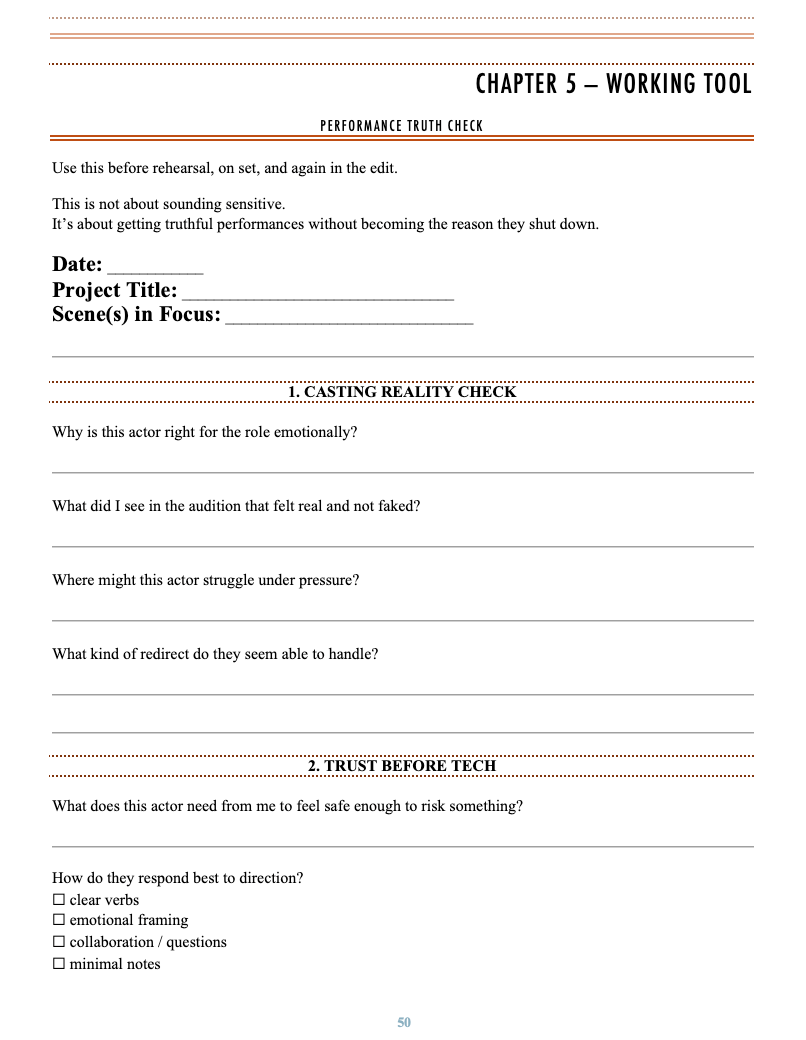
Performance Truth Check
Helps you direct actors toward truthful behavior instead of vague “be sadder” nonsense.
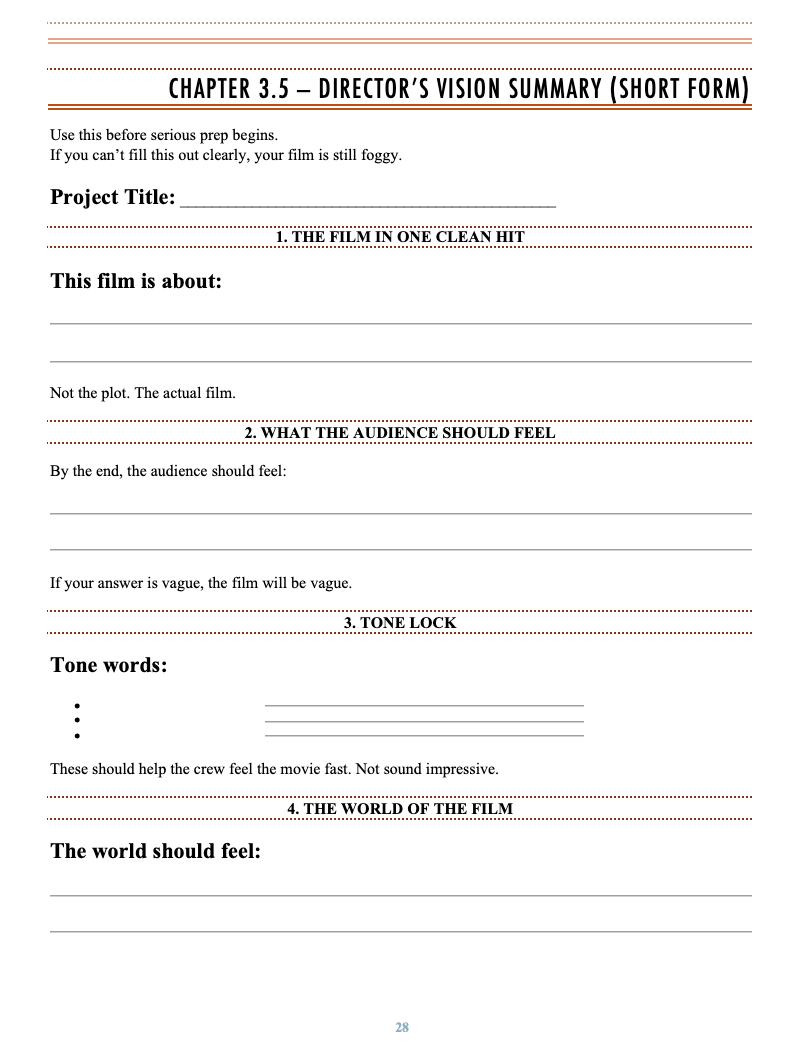
Director’s Vision Summary
Helps you lock tone, feeling, visual approach, and what must survive from script to screen.
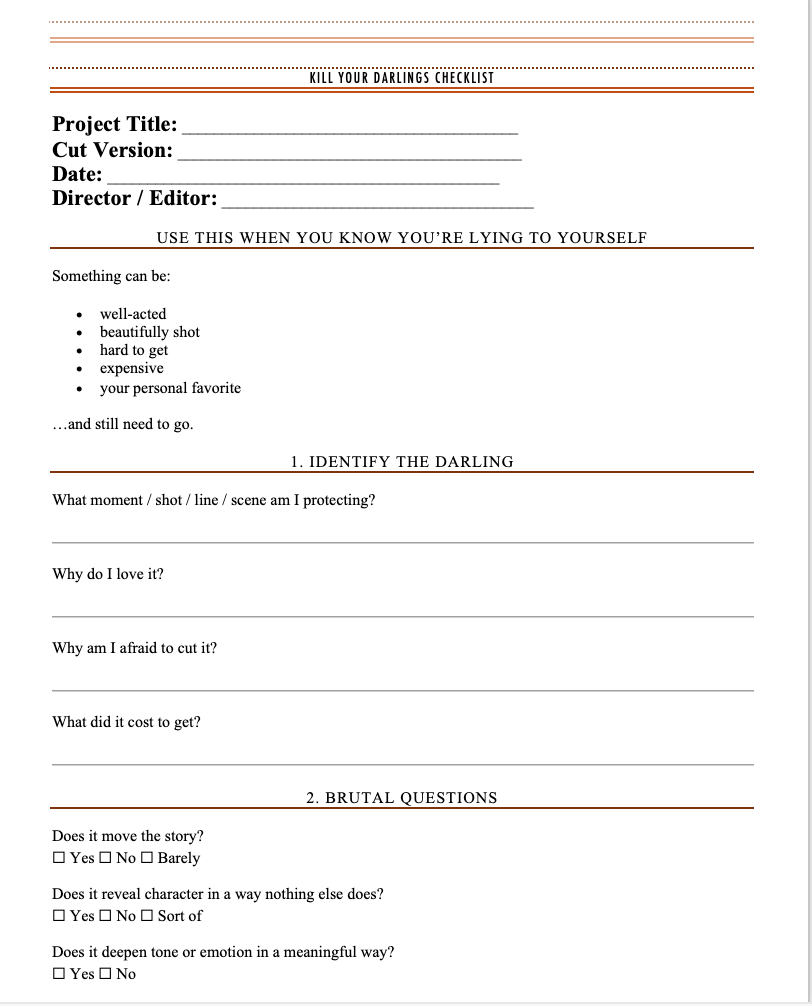
Kill Your Darlings Checklist
Helps you cut the shot, line, or scene you love when it’s weakening the film.
Who This Book Is For
(And who it’s not)
🎬 First-time directors with the fire but no roadmap — who don’t want to burn their one good shot learning everything the expensive way.
🎬 Filmmakers who’ve already shot something and came away frustrated — because passion wasn’t the problem, but the lack of a plan, strategy, or clear next move was.
🎬 Indie filmmakers juggling five roles, three favors, and one small budget — still determined to make it work.
🎬 Film students who’ve learned the theory and now want the real-world version — the part you don’t get from PowerPoints.
🎬 Writers, artists, and storytellers who’ve carried a film in their head for years and are finally ready to pull it out — rough edges and all.
🎬 Midlife pivots and late bloomers who’ve been circling the idea for decades and are ready to go all in — no film school, just guts and a good guide.
🎬 And yeah — even the person who asked, “How hard could it be?” — but is smart enough to ask for help before finding out.
Who This Book Isn't For
(And hey — no hard feelings)
🚫 People who think directing is just yelling “action” and pointing at stuff.
🚫 Anyone looking for a shortcut to Sundance. This book won’t spoon-feed you fame.
🚫 Gear junkies hunting for camera reviews and spec sheets. That’s not what this is.
🚫 Readers looking for theory, footnotes, and historical comparisons.
🚫 People who don’t actually want to make a film — just talk about making one.
If you’re looking for shortcuts, hacks, or someone to lie to you — this isn’t it.
What Makes It Different
This isn’t a highlight reel of my career.
It’s the screw-ups, fixes, patterns, and hard-earned lessons that tend to show up when a film gets real.
The things you wish someone had told you before you rented the camera, called the crew, or paid that non-refundable festival submission fee.
But this isn’t just a list of warnings.
The working tools are there because better films usually come from better decisions made earlier.
They help you clarify the story, strengthen the script, direct actors with more purpose, protect the shots that matter, and listen to what the edit is actually telling you.
No jargon.
No ego.
No pretending the whole thing is supposed to be effortless.
No “what the hell do I do now?” panic.
The goal isn’t to make your film perfect.
And no, I’m not promising this will win you an Academy Award.
Maybe that happens someday. And if it does, remember who helped you avoid your first festival submission meltdown.
I accept yacht invitations in the Mediterranean.
But for now, the goal is simpler:
Make the film clearer.
Make it stronger.
Make it more intentional.
Keep your crew intact.
And finish with something you’re actually proud to show.
Where Films
Actually Break
Most filmmaking books overcomplicate the wrong things.
They drown you in camera specs, gear lists, and technical rabbit holes — like that’s filmmaking.
It’s not.
Great films don’t start with gear.
They start with judgment.
What to focus on.
What to ignore.
What to protect when the day starts slipping.
I didn’t wake up wanting to direct.
I worked my way there — photography, lighting trucks, grip, DP — learning the hard way where things fall apart.
By the time I directed a feature on 35mm, I understood something simple:
Starting a film is easy.
Finishing it costs you.
Not by making the process painless.
It won’t.
But by helping you see the weak spots earlier, make clearer decisions, and avoid the kind of mistakes that quietly drain your schedule, your budget, your crew, and your confidence.
What You Actually Get Inside
Working tools for clearer choices, stronger prep, better performances, cleaner edits, and fewer expensive surprises.
Directing & Working
With Talent
Give actors playable direction, protect emotional truth, and keep performances from drifting.
Make It Look Like a Movie
Prioritize what actually shows up on screen — especially when money, time, and crew are tight.
Editing, Finishing & Reality
Make post decisions around pacing, clarity, cuts, sound, and the difference between “done” and actually finished.
Festivals, Distribution
& Aftermath
Understand submissions, rejection, positioning, launch choices, and what happens after export.
Story, Script & Vision
Clarify what the film is really about before you start building the wrong movie.
Production Survival
Navigate crew dynamics, time pressure, budget limits, and the thousand tiny decisions that hit once theory leaves the room.
Why It’s Called the Working Edition
This isn’t a textbook.
It’s a working document.
Read a chapter. Stop.
Write in it. Cross things out. Argue with it.
The point isn’t to admire the advice.
The point is to use it while you can still make better choices.
Before the set, the edit, or the deadline starts making them for you.
"Because if you don’t understand where films actually break, none of the advice matters."
Before You Buy This...
Look — I know how these pages work.
You see the price. You scroll around. You wonder what the catch is.
Is this really the thing?
Is there a course behind it?
A fake countdown clock?
A “limited-time offer” that somehow lasts forever?
A bigger, shinier upsell waiting after the button?
No.
This is the thing.
Twenty-seven bucks. Instant download. No upsell maze.
I’ve spent a long time teaching film, and I’ll admit something: I’m a little selfish.
For years, I’ve told students I have an ulterior motive.
I want to give them as much useful knowledge as I can because one day, one of them might end up wildly successful, invite me onto their yacht in the Mediterranean, and cover all expenses for me and whoever I feel like bringing.
Still waiting on the yacht, by the way.
But the real motive is simpler:
I want them to take their work and future seriously and give themselves a real chance to make something they’re proud of.
That’s where this workbook comes from.
It’s here to help you take the work seriously enough to actually make the film — and make it better than it would have been without a plan.
Passion matters.
Corny or not, it does.
But passion without a plan can burn through money, time, crew goodwill, and whatever sanity you walked in with.
This is 260 pages of hard-earned filmmaking experience, working tools, checklists, production forms, and practical guidance built to help you make better decisions from idea to finished film.
Not magic.
But maybe the closest thing I can hand you to a movie-making survival kit.
You’re going to learn some of these lessons one way or another.
On set.
In post.
At the festival deadline.
Or here, before they cost you more than they should.
That’s the whole offer.
This just makes the lessons a hell of a lot less expensive.
— Rob Tuscani
P.S. This is not meant to be swallowed whole.
The workbook follows the way a film actually gets made: story, script, prep, production, edit, festivals, and launch.
Work the stage you’re in. Print the pages you need. Make the next decision.
That’s how films get finished.
One stage at a time. One hard choice at a time. And hopefully, at the end, something you’re damn proud to show.