CineSight Briefs · Issue 008 · September 24, 2026
For most of the generative-AI boom, the question was whether a machine could make a convincing image or shot.
That isn’t going away. But some of the more consequential developments now involve something else: giving AI and computational systems specific filmmaking jobs.
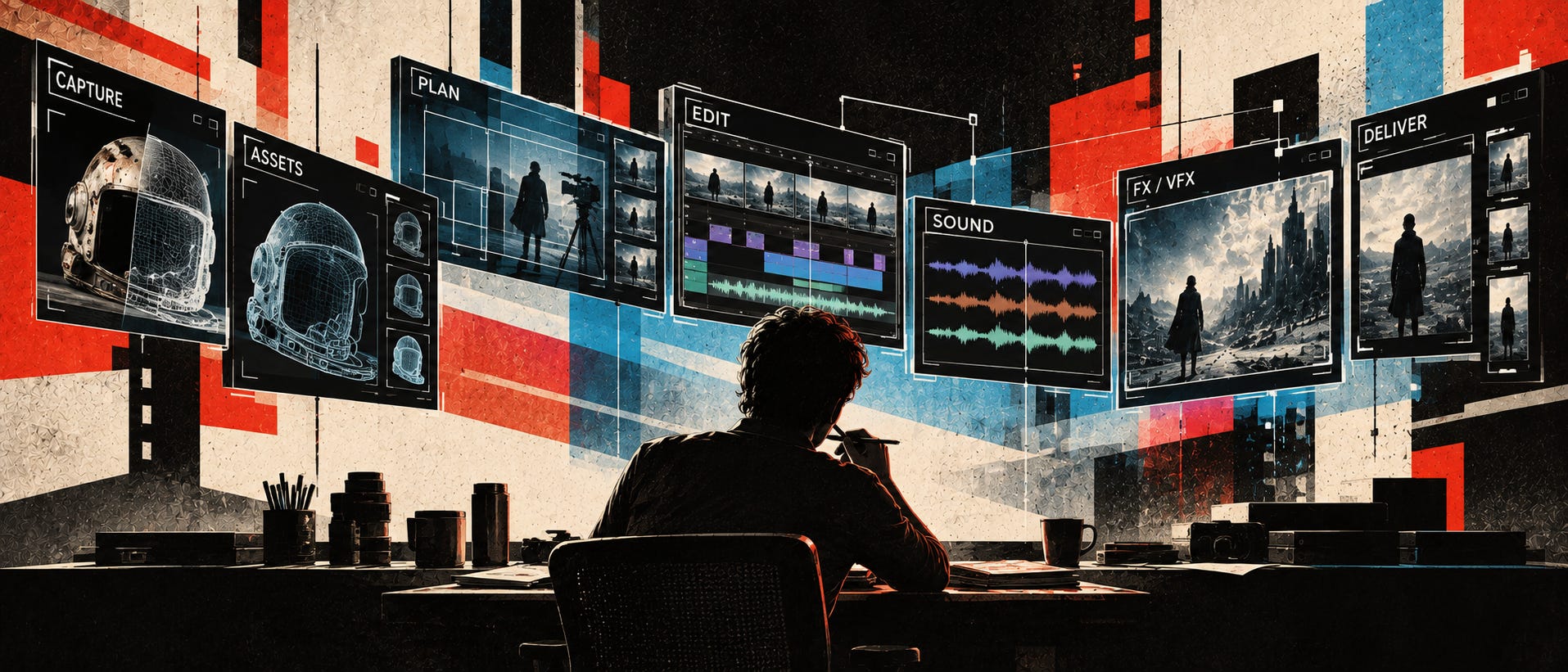
A camera file becomes a 3D object. An editing assistant works within written editorial rules. Filmmakers build small tools around recurring production tasks. Film courses are teaching complete AI workflows instead of isolated prompts.
The interesting question is becoming less “What can this thing generate?” and more “What part of the filmmaking process can it actually handle?”
IN THIS ISSUE
CANON TURNS ONE PHOTO INTO A 3D ASSET
MIGHT AFFECT · CAMERA / VFX
Canon’s new Dual Pixel 3D Converter uses depth and phase-detection information captured in a single compatible photograph to produce 3D imagery, including OBJ and GLB models that can move into standard 3D software. Canon says the Windows-only application will be available beginning October 8 and will be free at launch, although terms may change later.
It isn’t limited to the new EOS R8 Mark II. Several EOS R cameras and specified RF lenses support Dual Pixel RAW files, while the R8 Mark II can also provide JPEGs with the required distance information. Canon itself emphasizes close-up subjects and objects such as food and plants, so the useful filmmaking question is prop and object capture, not scanning entire sets.
Consequence: A production camera can increasingly capture something that later becomes more than a photograph. It can become a manipulable post-production asset.
Source: Canon U.S.A., September 15, 2026. Canon Dual Pixel 3D Converter
AI EDITING GETS RULES, NOT JUST PROMPTS
MIGHT AFFECT · EDITOR / PRODUCER
Reuters announced an integration between its MCP server and CuttingRoom’s browser-based ShortCut system. A newsroom can connect its own Reuters account, bring licensed Reuters video alongside its internal footage, search for material conversationally and delegate operations including cutting, mixing, color correction, captions, graphics and reformatting.
The more interesting part is that customers can write the editorial rules the assistant should follow in plain language, while retaining control of their data and interaction with the system. Reuters announced the partnership through its Media Center rather than as newsroom reporting, and the announcement did not publish measured accuracy, error rates or editing-time reductions.
That makes this less a story about an autonomous editor than about bounded delegation:
Approved material.
Defined rules.
Delegated operation.
Human review.
Consequence: Agentic editing is beginning to acquire operating policies, not merely better prompts.
Source: Reuters Media Center, September 12, 2026. Reuters and CuttingRoom partnership
AI FILMMAKING EDUCATION BECOMES A REAL CATEGORY
AFFECTS · EDUCATOR / FILMMAKER
UCLA Extension began its fall AI Toolsets and Workflows for Creative Production course on September 22. The 11-week, $835 course focuses on connecting text, image, video and audio tools into repeatable production pipelines, and explicitly grounds those workflows in human judgment, storytelling intent and hybrid filmmaking. UCLA estimates that students may spend about another $163 per month on software beyond Adobe.
Final Pixel Academy begins a 13-module online program September 28 covering computer vision, tracking, agents, connected workflows, rights, security and responsible AI. India’s Film and Television Institute of India has scheduled a Centre for Open Learning workshop called The Art of Filmmaking & The Craft of AI Cinema for September 29 through October 13. FTII’s own curriculum translates traditional concepts directly into AI production language, including shot grammar becoming prompt language and the shot list becoming a generation plan. The FTII workshop requires at least 15 participants to run.
AI5 Academy is also running a 16-week AI-first production course spanning concept, screenplay, visual development, generated cinematography, performance, sound, editing and release. Its own pitch explicitly says it teaches workflow and creative decision-making rather than dependence on one platform, and that its tool stack will change as stronger tools appear.
That last point matters to CineSight.
“Teach the process. Update the tools.” is not, by itself, a unique position anymore.
A more meaningful distinction for the First Film Field Guide and Digital Field Notes is the persistent, student-owned decision record: tools that follow the filmmaker through a real project without turning the student’s creative process into somebody else’s platform data.
Consequence: The market is validating AI-filmmaking education while simultaneously raising the bar for what makes an educational system distinctive.
Sources: UCLA Extension course · Final Pixel Academy · FTII workshop · AI5 Academy
QUICK BRIEFS
AI TRIES TO LEARN CAMERA LANGUAGE
MIGHT AFFECT · DIRECTOR / CINEMATOGRAPHER
A September 10 preprint called CamPilot describes a multi-agent system designed around cinematographic planning, including camera angle, movement, focal behavior and relationships among shots. The researchers say the system learned camera-work patterns from roughly 14,000 clips from professional movies and introduced a benchmark called CamEval. The work has not been peer-reviewed.
More important than the performance claims is the problem the researchers identify: current generated-video systems still struggle with professional camera language and multi-shot continuity.
Consequence: Camera planning could become another useful comparison exercise. Let the student design coverage. Let the machine design coverage. Then require the student to explain why one choice serves the scene better.
Source: arXiv preprint, September 10, 2026. CamPilot paper
AUTODESK COULDN’T PROMPT AWAY A CONTINUITY ERROR
REALITY CHECK · DIRECTOR / EDITOR
Autodesk’s own AI-assisted short Robots of the Wild West contains a simple continuity problem: a character sits beside another character at a table and appears across the corner from her a shot or two later.
Autodesk VP of M&E Industry Strategy Maurice Patel told Creative Bloq that the team recognized the problem and tried to fix it through prompting, but couldn't. Starting the sequence again wasn't worth the extra effort for the demonstration, so the error stayed in the film.
That limitation is useful precisely because Autodesk acknowledged it.
Consequence: Generating a believable individual shot and maintaining spatial continuity across a scene remain different problems.
Source: Creative Bloq, September 21, 2026. Autodesk continuity interview
GOOGLE LETS CREATORS BUILD THEIR OWN FLOW TOOLS
MIGHT AFFECT · EDITOR / SOUND / MOTION DESIGN
Google Labs released six creator-built Flow Tools on September 23. They can be duplicated, remixed or built from scratch by describing the workflow the user wants.
Several are directly relevant to filmmaking. Mondo Sónico creates synchronized ambiance, foley, and contextual effects on separate editable tracks that can be exported as stems. CollageMotion Pro automates animated mixed-media collages for documentary-style storytelling. SwissFlow Studio converts scripts into motion graphics. CaptionCast transcribes, styles, and animates multilingual captions.
The individual tools are useful, but the larger signal may matter more. Instead of forcing filmmakers into one fixed interface, Flow increasingly lets them build narrow tools around a recurring production problem.
Consequence: AI filmmaking software may be moving toward small, customizable workflow tools rather than one giant application that supposedly does everything.
Source: Google Labs, September 23, 2026. Google Flow Tools announcement
PREMIERE’S GENERATIVE TIMELINE TOOLS LEAVE BETA
AFFECTS · EDITOR
Adobe has now released Generate Video and Generate Sound Effects through Premiere’s Generative Media Tool. Premiere 26.5 can place generated material directly into a sequence as editable clips, alongside Paper Edit and expanded camera-format support.
Adobe’s own community already contains reports of generation failures, inconsistent reference behavior, and regeneration problems. Those posts are individual user reports, not controlled testing, but they illustrate why shipping a feature and trusting it under deadline pressure are not the same thing.
Consequence: The question is no longer whether generated media will enter the NLE. It has. The useful question now is whether these systems become reliable enough to depend on during real post-production.
Sources: Adobe, September 2026. Premiere release notes · Adobe community release thread
WHAT IT MEANS FOR FILMMAKERS
The common thread this week isn’t that AI suddenly learned filmmaking.
It is that AI and computational tools are moving from making things toward doing specific jobs inside the filmmaking process.
Canon is turning captured information into a 3D asset. Reuters and CuttingRoom are attaching rules to delegated editorial work. Google is letting filmmakers build narrow workflow tools. Premiere is putting generated material directly into the edit. Researchers are trying to model camera planning rather than simply generate prettier pictures.
And then Autodesk gives us the useful counterexample: the machine can produce convincing shots and still lose track of where the actor is sitting.
Those aren’t contradictions. They are exactly where the technology is right now.
The systems are becoming increasingly capable at tasks.
Filmmaking still requires somebody to understand the movie.
WORTH YOUR TIME
Pay attention to tools that remove a specific production obstacle.
Can it turn a photographed prop into a useful VFX asset?
Can it find the right material faster?
Can it separate sound into something you can actually work with?
Can it carry out a repetitive editorial operation while following rules you establish?
Can you inspect what it changed?
Can you undo it?
Can you keep working if that service disappears next month?
Those questions are more useful than asking which company currently has the best AI filmmaker.
IGNORE THIS WEEK
Ignore declarations that AI has learned cinematography because a research system can select camera moves.
Ignore claims that 3D scanning has been replaced before anyone has tested difficult production objects.
Ignore the assumption that a feature appearing inside Premiere makes it dependable.
And be skeptical of any AI-filmmaking course whose primary value is access to today’s list of software.
That list will change.
The filmmaking problems won’t.
THE CINESIGHT TAKE
The most interesting transition in AI filmmaking may be happening quietly.
The technology is starting to receive assignments.
Find this.
Clean that.
Turn this object into an asset.
Build this sound bed.
Assemble these shots.
Follow these rules.
Generate this missing piece.
That can be enormously useful.
But a collection of successfully completed jobs is not automatically a film.
Continuity matters. Performance matters. Rhythm matters. Point of view matters. Sometimes the technically cleaner take is the wrong take. Sometimes the beautiful shot needs to die. Sometimes the right editorial decision is to do nothing and stay on somebody’s face for three more seconds.
Those decisions are not obstacles surrounding filmmaking.
They are filmmaking.
Use the machine for the jobs it can do.
Keep responsibility for the movie.
CHECK THE REPORTING
Canon U.S.A. · September 15, 2026
Dual Pixel 3D Converter and EOS R8 Mark II
Canon DP3D information
Reuters Media Center · September 12, 2026
Reuters and CuttingRoom AI-assisted editing partnership
Reuters announcement
UCLA Extension · Fall 2026
AI Toolsets and Workflows for Creative Production
Course page
Final Pixel Academy · September 2026
AI for Filmmakers
Course page
Film and Television Institute of India · September 2026
The Art of Filmmaking & The Craft of AI Cinema
FTII workshop
AI5 Academy · September 2026
AI Filmmaking
Course page
CamPilot · September 10, 2026
Multi-Agent Cinematic Assistant for Camera-Controlled Movie Generation
arXiv preprint
Creative Bloq · September 21, 2026
Autodesk’s AI-film continuity problem
Interview/report
Google Labs · September 23, 2026
Six new Google Flow Tools
Google announcement
Adobe · September 2026
Premiere 26.5 generative-media release
Premiere release notes
A NOTE ON HOW THIS ISSUE WAS MADE
I set the editorial direction, selected the stories and made the final calls. AI assisted with research discovery, organization, drafting, and verification.
We checked significant factual claims against primary sources whenever possible. Where reporting depended on company announcements or individual user reports, the story makes that distinction.
ABOUT CINESIGHT BRIEFS
AI is changing filmmaking.
CineSight separates signal from noise, helping filmmakers make better decisions with practical information rather than hype.
We follow the technology.
But the movie comes first.